
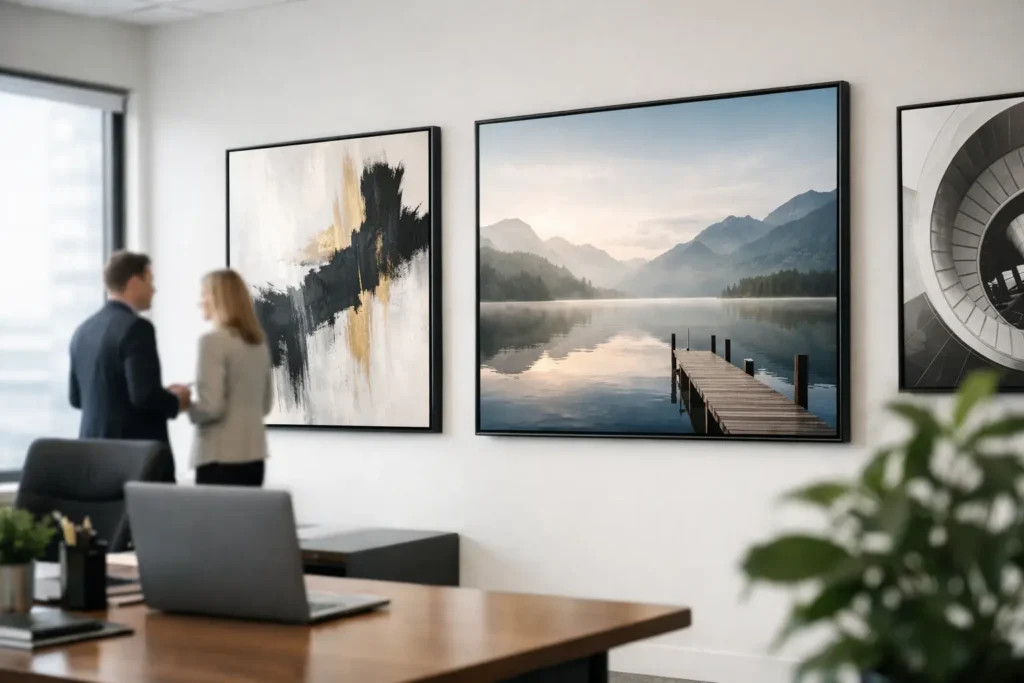
A blank office wall says more than people think. It can read temporary, flat, unfinished. The right large printable art for office walls changes that instantly. It gives the room a point of view, sharpens the atmosphere, and makes the space feel considered rather than merely occupied.
That matters whether you are styling a private studio, a client-facing office, a startup floor, or a home workspace that needs more edge. Art at scale does more than fill space. It sets tone. It frames how people focus, how a brand feels, and how a room holds visual tension without looking cluttered.
Why large-scale wall art belongs in the office
Small pieces often disappear in office settings. Desks, monitors, shelving, glass partitions, and task lighting already create visual noise. Oversized art cuts through it. It anchors the room and creates hierarchy, which is one of the fastest ways to make a workspace feel polished.
There is also a psychological effect. Strong wall art can make an office feel less generic and more intentional. In creative spaces, that can support energy and identity. In corporate or client-facing settings, it signals taste, confidence, and clarity. Even in a minimalist office, one striking print can do the work of several decorative objects.
Printable art adds another advantage: flexibility. Instead of being boxed into one fixed size or frame, you can scale the artwork to the wall you actually have. That is especially useful in offices, where dimensions vary wildly from narrow corridors to wide conference walls.
What makes large printable art for office walls effective
The best large printable art for office walls is not simply big. It is composed for impact. Scale only works when the image has enough visual strength to hold it.
High contrast is often the difference. Black-and-white photography, conceptual portraiture, bold type, surreal compositions, and clean retro graphics all tend to perform well at larger sizes because they remain legible from a distance. They read clearly across the room, not just up close.
Minimalism also matters, but not the bland version. A spare composition with tension, mood, or attitude feels elevated. It gives the eye room to breathe while still carrying presence. In office interiors, that balance is useful because the room already contains functional elements. The art should heighten the environment, not compete with every object in it.
Then there is subject matter. Soft florals and generic landscapes may work in certain hospitality spaces, but most modern offices benefit from something sharper. Conceptual pieces, monochrome portraits, statement posters, abstract geometry, and editorial-style visuals usually feel more aligned with contemporary workspaces. They project direction.
Match the art to the kind of office you have
Not every office needs the same visual energy. A founder’s private office can carry more personality than a formal boardroom. A home office can be more expressive than a shared workspace. The room should guide the art, not the other way around.
In executive or client-facing spaces, look for work that feels refined and controlled. Large monochrome pieces, restrained surrealism, and minimal conceptual prints create impact without becoming distracting. They feel sophisticated, not noisy.
In creative studios, design firms, and fashion-adjacent workplaces, you can push further. Retro graphics, bolder portraiture, provocative poster-style art, and sharp visual contrast often feel right at home. These spaces benefit from a little attitude.
Home offices sit somewhere in between. The best choice depends on whether the room needs calm or momentum. If your work requires long focus, a cleaner composition can support that. If the room feels stale, one dramatic oversized piece can shift the entire mood.
Size is where most people get it wrong
The common mistake is going too small. On a large office wall, undersized art can look apologetic. It reads like a placeholder rather than a design decision.
A good rule is to let the artwork span around two-thirds to three-quarters of the available wall width, especially above a desk, credenza, or seating area. If the wall is wide, consider a single oversized print with presence rather than several medium pieces fighting for attention. One strong statement often feels cleaner and more premium.
That said, bigger is not always better. In compact offices, art that is too large can make the room feel compressed. You want tension, not overload. Measure the wall, account for furniture below it, and think about viewing distance. Conference rooms and open-plan offices can handle more scale because people experience the art from farther away.
This is where printable formats have a real edge. You can choose the dimensions based on the architecture instead of forcing the room to adapt to a pre-made piece.
Framing, finish, and print material matter
Digital art gives you freedom, but freedom needs editing. The same print can feel sleek, dramatic, or underwhelming depending on how it is produced.
For contemporary offices, matte paper is usually the strongest choice. It reduces glare from overhead lighting and screens, which is crucial in workspaces. Gloss finishes can intensify contrast, but they can also create reflections that flatten the image from certain angles.
Framing should support the piece, not dilute it. Thin black frames feel crisp and architectural. White frames can work in brighter spaces, though they usually create a softer effect. Frameless poster mounts bring a more casual, editorial energy, which can suit creative environments but may feel too loose for formal offices.
Canvas can work, but it depends on the artwork. Graphic, high-contrast pieces often look sharper behind glass or as fine art prints. Canvas tends to soften edges, which is not always ideal for conceptual or poster-style work.
Placement changes the entire read
Office art should not float randomly. Placement determines whether the room feels curated or improvised.
Above a desk, keep the piece centered and substantial enough to balance the furniture below. In a meeting room, place the work where it can be seen without competing with presentation screens. In reception areas, choose a wall that lets the art act as a visual introduction to the space. The first impression should feel deliberate.
Height matters too. People often hang art too high in offices because ceilings are taller and walls feel expansive. The center of the piece should still sit close to eye level unless the furniture arrangement calls for a slightly higher position. If you are creating a gallery-style statement across a wider wall, keep spacing precise. Loose spacing quickly looks accidental.
Style directions that hold up in modern offices
Some styles age better than others. Trend-heavy art can date a workspace fast, especially in professional settings. The safer move is not boring art. It is art with a strong visual backbone.
Black-and-white conceptual work has staying power because it feels editorial, architectural, and clean. Surreal portraiture can be compelling in offices that want an edge, but it should still feel composed rather than chaotic. Retro poster designs work well when the color palette is disciplined. Typography-based statement prints can be effective too, though they need confidence and excellent restraint to avoid looking gimmicky.
If the office already has bold materials like dark wood, concrete, smoked glass, or metal, monochrome art often amplifies that sophistication. If the room is very neutral, a controlled shot of color can add tension without disrupting the palette.
The real advantage of downloadable office art
Speed is part of the appeal, but it is not the only reason downloadable art works so well in office settings. It gives you control. You can print locally, choose a premium paper, select the exact dimensions, and frame it to match the room. That is hard to beat when timing matters or when you need a custom fit.
It is also practical for growing businesses and evolving interiors. If you move offices, change layouts, or want to update a room without starting from zero, printable art adapts. The artwork stays relevant even when the wall changes.
For design-conscious teams or individuals, that flexibility feels less like compromise and more like intelligent sourcing. You get the visual hit of gallery-inspired work without shipping delays, stock limitations, or being locked into one format. Brands like 21MXM build on that idea with high-resolution pieces designed to hold their presence at scale, which is exactly what office walls need.
Choose art that says something, even quietly
The strongest office interiors do not rely on filler. They use fewer pieces, better chosen. Large art should feel like part of the room’s identity – not an afterthought added once the furniture is in place.
If the wall is prominent, let the artwork be decisive. Choose a piece with contrast, a clear point of view, and enough visual discipline to live with every day. Office walls are not just background. They shape the way the space works, feels, and is remembered.
When the art is right, the room stops looking finished and starts looking intentional.