
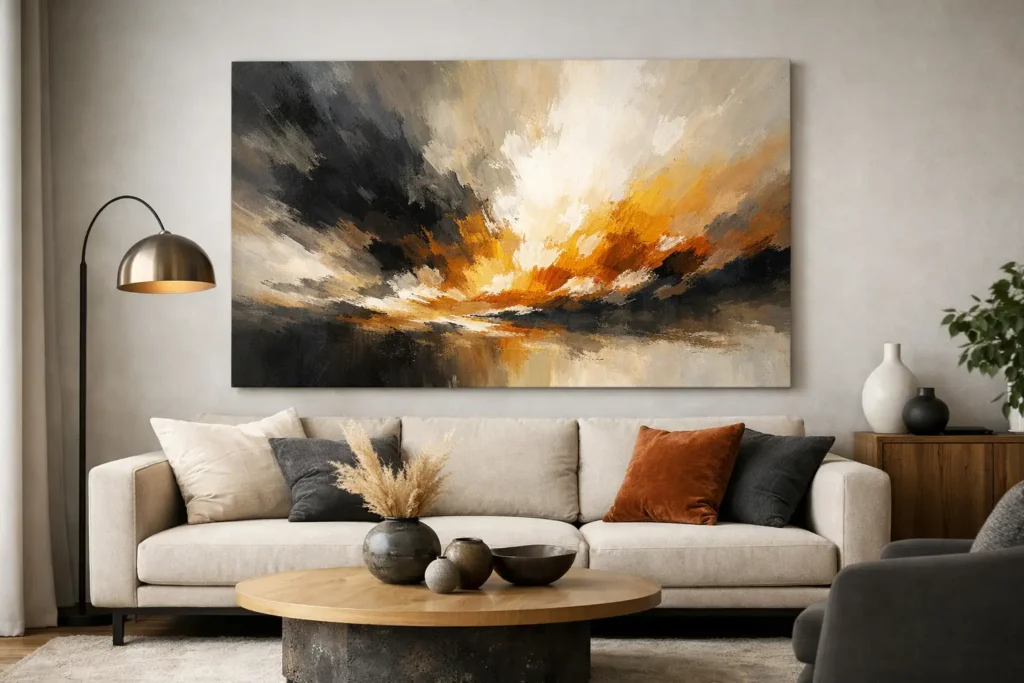
A blank wall in the living room does more than look unfinished. It flattens the entire space. The sofa can be right, the rug can be expensive, the lighting can be warm and intentional – and the room still feels like it never fully arrived. Statement art for living room styling changes that fast. It gives the space a point of view.
The difference is not just visual weight. It is identity. A strong piece of art can turn a neutral room into something edited, personal, and architecturally sharp. It can introduce tension, softness, irony, drama, or calm. More importantly, it tells people this room was considered.
What statement art for living room spaces actually does
Statement art is not just oversized decor. It is the visual anchor that holds a room together. In a living room, that matters because this is the space where everything competes at once – seating, lighting, textiles, storage, screens, and often open-plan sightlines. Without a focal point, the room can feel scattered.
A statement piece creates hierarchy. Your eye lands somewhere first, and that gives the rest of the room structure. In modern interiors, especially those built around clean lines and restrained palettes, art often carries the emotional load. It provides contrast against minimal furniture. It softens hard architecture. It adds intention where styling alone can start to feel generic.
That does not always mean loud color or maximal scale. A black-and-white portrait with enough attitude can command a room just as effectively as a saturated abstract. The key is presence. The work should feel deliberate, not like filler above the couch.
How to choose statement art for living room design
The smartest way to choose art is to stop thinking of it as a final accessory. Start with the room’s energy instead. Ask what the space is missing.
If the room feels too safe, choose art with tension – surreal imagery, conceptual composition, a face that holds the gaze a little too long. If the room feels visually busy, go sharper and more minimal. A striking monochrome print can cut through clutter better than another layered texture.
Scale matters immediately. Small art disappears in most living rooms unless it is part of a grid or salon arrangement. A statement piece needs enough size to hold the wall and speak to the furniture below it. That usually means going larger than instinct suggests. The common mistake is under-scaling because people fear overpowering the room. In reality, the room often looks more expensive when the art has confidence.
Subject matter matters too. Portraits create intensity and personality. Abstracts create movement and atmosphere. Retro posters bring graphic edge and cultural tone. Typography-based work can feel smart and fashion-aware, but it needs restraint or it starts reading as trend rather than taste. There is no single right category. There is only alignment between the artwork and the room’s mood.
Match the piece to the room’s architecture
Art never lives alone. It sits inside a frame of ceiling height, wall width, natural light, and furniture proportions. In a living room with tall ceilings, vertically oriented work can emphasize height and make the space feel more gallery-like. In a low, wide room, a horizontal piece above the sofa tends to feel more integrated.
If your walls are heavily broken up by windows, shelving, or a TV, a strong central piece may work better on an adjacent wall rather than fighting for attention in the obvious spot. Sometimes the most effective placement is the one that interrupts expectation.
Color, contrast, and restraint
A lot of people choose living room art by matching a color from the rug. That is safe, but rarely memorable. Better rooms work with contrast.
If your living room is built around beige, stone, oak, boucle, and soft forms, the right statement art can add edge. Black-and-white work is especially powerful here because it sharpens the whole palette without introducing visual clutter. It brings discipline to softer interiors and creates a premium, editorial finish.
If your space already has strong color, statement art can either intensify that drama or act as a controlled counterpoint. Both approaches work. A room with deep rust, walnut, and brass might benefit from a monochrome conceptual print that gives the eye a place to rest. On the other hand, a room with already graphic interiors may be able to handle a bolder retro or surreal piece. It depends on whether you want cohesion or friction.
Restraint is part of the equation. One commanding artwork often does more than several medium-impact pieces. Not every wall needs to speak at once.
The case for black-and-white statement art
Black-and-white art has range that color-heavy decor often lacks. It can feel classic, minimal, intellectual, cinematic, or severe depending on the image. In living rooms, that flexibility is useful because the space changes throughout the day. Morning light, evening lamps, and screen glow all affect how art reads.
Monochrome pieces hold their authority across those shifts. They also layer easily with changing interiors. If you swap pillows, move furniture, or update accent colors seasonally, black-and-white art remains stable. It does not trap the room into one palette.
There is also a clarity to it. Conceptual black-and-white work feels edited. It suggests choice rather than decoration. For design-conscious spaces, that distinction matters.
One large piece or a curated set?
A single oversized piece has immediate drama. It is clean, architectural, and hard to ignore. If your living room is already styled with strong furniture shapes, one large artwork usually delivers the most impact with the least visual noise.
A curated set works differently. It introduces rhythm and layering. This can be ideal if you want the room to feel more collected and less formal. The risk is dilution. If none of the pieces are strong enough individually, the grouping can feel like background texture instead of a statement.
The better approach often comes down to the room’s role. If the living room is your social space, where first impressions matter, one bold piece tends to land harder. If it is a more intimate, reflective room, a tightly edited series can feel richer and more personal.
Why print flexibility changes the equation
This is where digital art makes practical sense for modern interiors. With downloadable statement pieces, you are not locked into one factory-chosen size or frame. You can scale the artwork to the wall you actually have, print on the material that suits your interior, and choose a frame finish that fits the room rather than settling for whatever arrived in a box.
That flexibility matters because living rooms are rarely standard. A downtown apartment wall, a suburban open-plan family room, and a styled office lounge all need different proportions. High-resolution downloadable art lets you adapt the same strong visual idea to your exact space.
It also removes the slow part. You can find a piece, print it at the right size, and change the room’s entire atmosphere without waiting through shipping delays or dealing with fragile oversized deliveries. For renters and frequent movers, that control is even more valuable.
Brands like 21MXM sit right in that sweet spot – bold, contemporary wall art with the freedom to print at the scale your room demands.
Framing and placement make or break the result
Even exceptional art can look average if the framing is wrong. Thin black frames are reliable for modern spaces because they keep the focus on the image and add crisp definition. White frames can work in lighter interiors, but they tend to soften the statement. Natural wood introduces warmth, which can be useful if the artwork itself is stark.
Placement should feel intentional, not timid. Above a sofa, art should generally relate to the width of the furniture below it and sit low enough to connect visually with the seating area. If it floats too high, the wall and furniture separate into two unrelated zones.
Lighting helps. A nearby floor lamp, directional sconce, or simply a clean wash of natural light can make a statement piece feel curated instead of just hung.
What to avoid when choosing statement art
The first mistake is choosing art that is only trendy. If the appeal disappears as soon as the trend cycle shifts, it was never a statement. It was a placeholder.
The second is playing too safe. Art that offends no one usually excites no one either. Your living room does not need chaos, but it should have some conviction.
The third is treating art as a color-matching exercise. Cohesion matters, but overly coordinated rooms can feel flat. The best statement art introduces something the furniture cannot.
A living room should not look undecided. It should feel edited, charged, and unmistakably yours. When the right artwork hits the wall, the room stops asking for more and starts saying exactly what it came to say.