
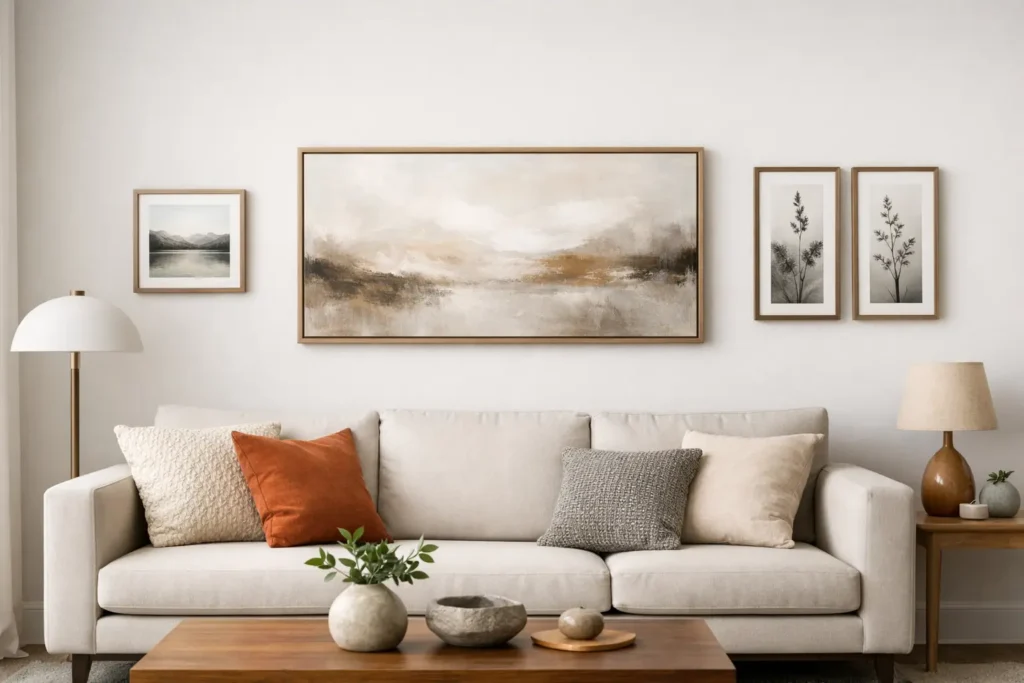
A sofa can be perfect – clean lines, great texture, the right silhouette – and still feel unfinished. Usually, the problem is the wall behind it. If you are asking what size art above sofa works best, the answer is not random, and it is definitely not one small frame floating in a sea of blank space.
The right scale makes the whole room feel sharper, more intentional, and more expensive. The wrong scale makes even beautiful art look like an afterthought. This is one of those design moves that changes everything fast.
What size art above sofa actually works?
The simplest rule is this: your art should span about two-thirds to three-quarters of the sofa’s width. That proportion tends to feel balanced without looking cramped or oversized.
If your sofa is 84 inches wide, the ideal artwork width is usually somewhere between 56 and 63 inches. If your sofa is 96 inches wide, aim for roughly 64 to 72 inches of total art width. That total can come from one large piece, two panels, or a gallery-style grouping that reads as a single visual block.
This is the proportion designers return to because it creates tension in the right way. The art has presence, but the sofa still anchors the composition. Neither piece fights for dominance.
Why scale matters more than style
People often obsess over color palette or subject matter first. Those matter, but scale gets the first verdict. Before anyone notices whether the piece is surreal, minimal, retro, or conceptual, they register whether it feels right in the room.
Too small, and the wall looks disconnected from the furniture. Too large, and the arrangement feels heavy, almost like it is pressing down on the seating area. Good scale creates visual confidence. It tells the eye the room has been curated, not just decorated.
That is especially true in modern interiors, where clean lines leave very little to hide behind. In a pared-back room, proportion is the statement.
One large piece or multiple pieces?
Both can work. The better option depends on the mood you want.
A single oversized print feels bold, editorial, and controlled. It suits spaces that lean minimal or architectural. If you want the room to feel crisp and high-impact, one commanding piece is hard to beat.
A diptych or triptych gives you scale with more rhythm. It can feel slightly softer and more layered while still looking modern. This works well above longer sofas, especially if you want to echo the length of the furniture without installing one massive frame.
A gallery wall is the loosest option, but it still needs discipline. The mistake is treating it like scattered fragments. Above a sofa, a gallery arrangement should still read as one composition, with an overall width that follows the same two-thirds to three-quarters guideline.
What size art above sofa for different sofa widths
Here is where the rule becomes practical.
For a loveseat around 60 to 72 inches wide, art that spans 40 to 54 inches usually feels right. That could be one 40 x 30 print in a substantial frame, two medium pieces, or a small, tight grouping.
For a standard sofa around 78 to 90 inches wide, the sweet spot is usually 52 to 68 inches total width. This is where a large statement print really works. It gives the wall enough authority to match the furniture.
For an extra-long sofa or sectional with a visible back wall span of 96 inches or more, think bigger. Around 64 to 80 inches of total art width often feels balanced. This is the zone for oversized black-and-white photography, conceptual poster pairs, or a dramatic triptych with breathing room between panels.
If your sofa has very low arms and a sleek profile, you can push scale slightly larger because the furniture feels visually lighter. If the sofa is bulky, tufted, or deep, stay disciplined with width so the wall does not feel overloaded.
Height matters too
Width gets most of the attention, but height can make or break the composition. Art above a sofa should usually hang so the bottom edge sits about 6 to 10 inches above the back of the sofa.
That distance keeps the artwork connected to the furniture. If you hang it too high, the wall splits into separate zones and the room loses cohesion. This is one of the most common styling misses.
As for the artwork’s height, larger is often better than people expect, especially in rooms with standard 8- or 9-foot ceilings. A piece that is too short can look skimpy even if the width is technically correct. You want enough vertical presence to hold the wall, particularly if the sofa is long and low.
If you are building a multi-piece arrangement, measure the total outer dimensions, not just each frame. The entire grouping is what the eye reads.
When to break the rule
The two-thirds to three-quarters formula is strong, but not sacred. Some rooms need a different move.
If the sofa sits on a narrow wall between windows or built-ins, let the architecture set the limit. In that case, the art should relate to the available wall zone, not just the sofa width.
If your ceilings are unusually tall, a vertically stronger arrangement can help the room feel less flat. You may choose a slightly narrower piece with more height, or stack two works in a clean column. This can look striking in modern spaces, especially when the art itself has a graphic, fashion-led attitude.
If the sofa is part of a layered vignette with sconces, molding, or a console behind it, the artwork may need to be smaller because it is sharing visual territory. The goal is not to obey a formula. The goal is to create tension, balance, and presence.
Frame size changes the equation
This matters more than most people think. The print size and the final framed size are not the same thing.
A 24 x 36 print with a mat and substantial frame can end up several inches wider and taller overall. That added border can be a gift if you want a more gallery-like feel, but it can also push the piece beyond the ideal proportion.
This is where downloadable art has a real advantage. You are not locked into one factory-decided size. You can print the same file larger for a wide living room, smaller for a tighter apartment setup, or choose a framing style that changes the visual weight. That flexibility makes it easier to get the scale exactly right instead of settling for almost right.
Style should follow proportion, not replace it
A bold print does not need to be loud in color to dominate a room. Black-and-white artwork, surreal portraiture, and minimal conceptual pieces often feel even stronger above a sofa because they hold space with clarity.
That said, the bigger the artwork, the more its personality shapes the room. Oversized art becomes architecture. It controls mood, not just decoration. A stark monochrome portrait creates drama. A retro statement poster adds rhythm and wit. A minimal abstract brings calm, but only if the scale is generous enough to feel intentional.
If your room already has strong pattern, sculptural lighting, or saturated upholstery, art with cleaner lines can keep the composition sophisticated. If the room is quiet and restrained, a more confrontational piece can give it pulse.
A quick reality check before you hang anything
Tape the artwork dimensions on the wall first. Painter’s tape is not glamorous, but it is brutally honest. It shows whether the scale has presence, whether the spacing above the sofa feels tight enough, and whether the composition aligns with nearby windows, shelves, or lamps.
This is especially useful if you are choosing between one oversized piece and a grouped arrangement. On paper, both may fit. On the wall, one will usually feel more convincing.
If you want a living room that feels polished instead of pieced together, scale is the move to get right first. At 21MXM, that is part of the appeal of digital art – you can choose work for its attitude, then print it at the size your space actually needs.
The best art above a sofa does not merely fill a wall. It sets the room’s point of view, and once the scale is right, everything around it starts to look sharper.