
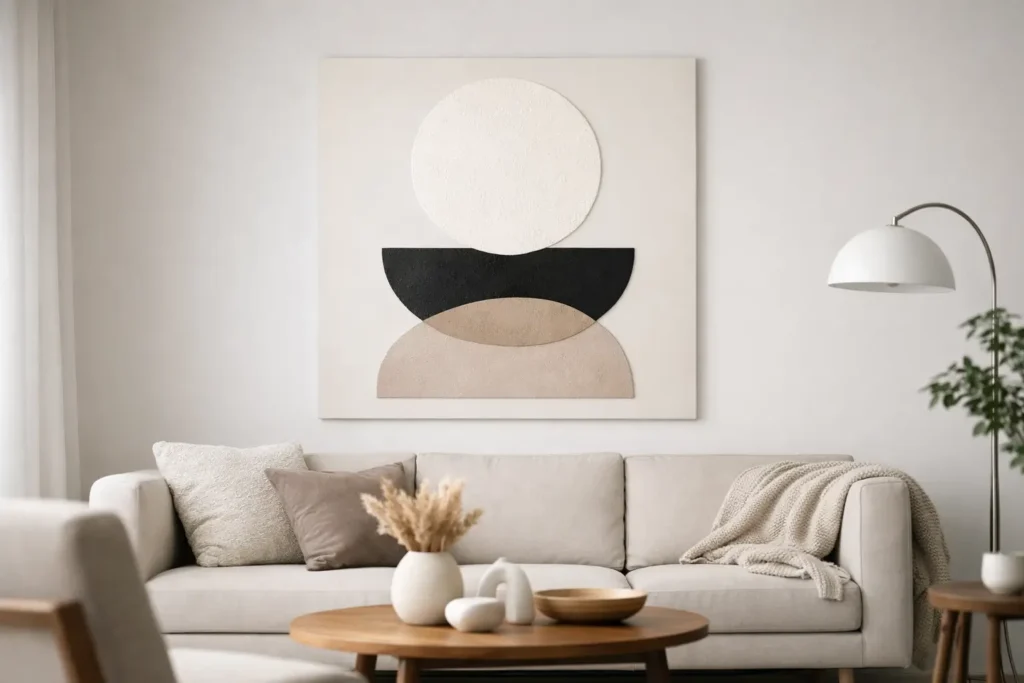
Some walls make a room feel finished. Others make it feel flat, even when the furniture is right and the lighting is expensive. The difference is often minimalist statement wall art – work that holds attention without clutter, adds edge without noise, and gives a space a point of view.
That balance is harder than it looks. Minimalism can easily turn cold. Statement pieces can easily turn heavy-handed. The sweet spot lives in tension: restraint with presence, simplicity with authority, clean lines with enough personality to shift the atmosphere of a room the second you walk in.
What minimalist statement wall art actually does
The phrase gets used loosely, but not every simple print deserves the label. Minimalist statement wall art is not just neutral decor with a lot of empty space. It is art that uses reduction as a strategy. Fewer elements, sharper impact. Less visual information, stronger emotional read.
In practical terms, that might mean a black-and-white conceptual print, an abstract shape with architectural weight, a surreal portrait with one dominant gesture, or typography that lands like a design object rather than a quote on a wall. The point is not to fill blank space. The point is to create focus.
This matters because modern interiors already carry plenty of information. Upholstery texture, kitchen finishes, shelving, hardware, flooring, screens, lighting – every surface competes. A strong minimalist piece cuts through that noise. It gives the eye somewhere to land. It tells the room what kind of room it is.
Why minimal works so well in modern interiors
Minimal art has range. In a small apartment, it keeps the room from feeling crowded. In a larger home, it prevents big walls from looking busy or overly staged. In a workspace, it adds identity without creating distraction. That flexibility is part of its appeal, but the real reason it works is contrast.
A minimalist piece introduces discipline. If your room has warm wood, curved upholstery, layered textiles, and ambient lighting, a crisp high-contrast print adds structure. If your room is already sleek and restrained, the right artwork keeps it from slipping into showroom emptiness. Minimal does not mean invisible. The best pieces sharpen the whole composition.
There is also a psychological effect. Rooms with too many decorative signals tend to feel temporary. Rooms with one clear visual anchor feel intentional. That is why statement art often does more for a space than another accent chair or another stack of objects on a console.
The difference between minimal and generic
This is where many people miss the mark. Minimalist art is not automatically elevated. A print can be sparse and still say nothing. Generic minimal decor often relies on safe palettes, predictable line drawings, and shapes that blend in politely. It may coordinate with the room, but it rarely transforms it.
Statement art needs authorship. It needs conviction. That can come through scale, composition, contrast, subject matter, or mood. A stark monochrome portrait has a different energy from a soft beige abstract, even if both are technically minimal. One recedes. One challenges the gaze.
If you want presence, look for pieces with tension. Strong negative space. Deliberate asymmetry. A single bold form. Typography with real graphic authority. Imagery that feels curated rather than filler. Minimalism works best when it edits hard, not when it plays safe.
Choosing minimalist statement wall art for your space
Start with the role the piece needs to play. Is it the focal point of the room, or the element that sharpens an already strong interior? In a living room, a large-scale print above the sofa can define the mood instantly. In a bedroom, the better move may be something quieter but still assertive – clean, moody, and controlled rather than loud.
Then consider contrast. If the room is soft and tonal, go graphic. If the room is highly contrasted already, a minimalist work with subtle texture or a surreal detail may create more sophistication than another blunt black block. It depends on what is missing. Great styling is rarely about matching. It is about correction.
Subject matter matters too. Abstract forms feel architectural and flexible. Portraits add psychology and edge. Typography feels fashion-led and editorial. Retro-inflected minimal prints can bring wit and rhythm. There is no universal best choice. The right choice is the one that reinforces the identity of the space instead of diluting it.
Scale is not optional
Most wall art problems are scale problems. People choose prints that are too small, then try to compensate with more decor around them. The result is fragmentation. A statement piece should not apologize for existing.
Above a sofa, art typically needs enough width to feel connected to the furniture. On a tall empty wall, vertical formats can pull the eye upward and make the architecture feel stronger. In narrow areas like hallways or entry zones, a single well-scaled piece often performs better than a busy gallery wall.
This is one of the strongest arguments for downloadable art. You are not locked into one manufacturer size or one frame format. You can print for the wall you actually have, not the wall a retailer assumed you had. That flexibility changes the outcome. A powerful image printed too small loses force. The same image scaled correctly can carry an entire room.
Black and white still leads for a reason
Color has its place, but black-and-white minimalist statement wall art remains one of the strongest tools in contemporary interiors. It is precise. It is graphic. It creates instant contrast and a gallery-like finish without begging for attention through brightness alone.
Black and white also travels well across styles. It works in modern lofts, softer organic spaces, masculine offices, polished apartments, and hospitality-inspired bedrooms. It can sit against white walls for a crisp editorial look or against darker paint for something more dramatic and cinematic.
That said, black and white is not automatically severe. The mood depends on the image. A conceptual portrait can feel intellectual. A surreal composition can feel mysterious. A retro statement poster can feel playful but still controlled. The palette is minimal. The expression does the heavy lifting.
How to style it without overstyling it
The fastest way to weaken a statement piece is to surround it with too much explanation. If the art is strong, let it breathe. Give it negative space. Avoid crowding it with competing accessories, overly decorative sconces, or a shelf full of small objects directly underneath.
Frames matter more than people think. Slim black frames keep the look clean and architectural. White frames can feel lighter and more gallery-driven. Natural wood can soften stark imagery, though it shifts the tone and works best when the room already carries warmer materials. Oversized mats can add refinement, but only if the art itself has enough visual weight to handle the extra breathing room.
Placement should feel intentional, not ceremonial. Art does not have to sit exactly at eye level in every context. Above a bed, it can float slightly higher. Leaning an oversized piece on a console can feel relaxed and fashion-aware. In a dining area, one bold print often outperforms multiple smaller works because it keeps the visual line clean.
Why digital art fits the way people decorate now
Interiors move faster than they used to. People relocate, repaint, upgrade furniture, switch rooms into home offices, and refine their style in stages. Waiting weeks for art, or settling for fixed formats, feels dated. Digital art aligns with how design-conscious people actually shop and style now.
Immediate access is part of the appeal, but control is the bigger advantage. You choose the size, the paper, the frame, and the finish. You can go polished and formal in one room, raw and oversized in another. The artwork stays consistent while the presentation adapts to the space.
That is especially useful with minimalist statement pieces, where material and scale have a huge effect on the final look. A conceptual black-and-white print can feel sharp and editorial on smooth fine art paper, or more tactile and atmospheric on a textured stock. One image, different attitude.
For a brand like 21MXM, that flexibility pairs naturally with the aesthetic itself: bold, contemporary work designed to land fast and look intentional without the drag of shipping delays or one-size-fits-all framing.
The real goal is not decoration
The best walls do more than look finished. They project taste. They set tone. They create a sense of self in a space that might otherwise feel efficient but forgettable. That is why minimalist statement wall art keeps earning its place in modern interiors. It does not rely on excess. It relies on precision.
If your room feels close but not complete, the answer may not be more furniture or more styling. It may be one piece with enough clarity, scale, and attitude to pull the whole space into focus. Choose the work that changes the air around it, and let the wall do what it was meant to do.