
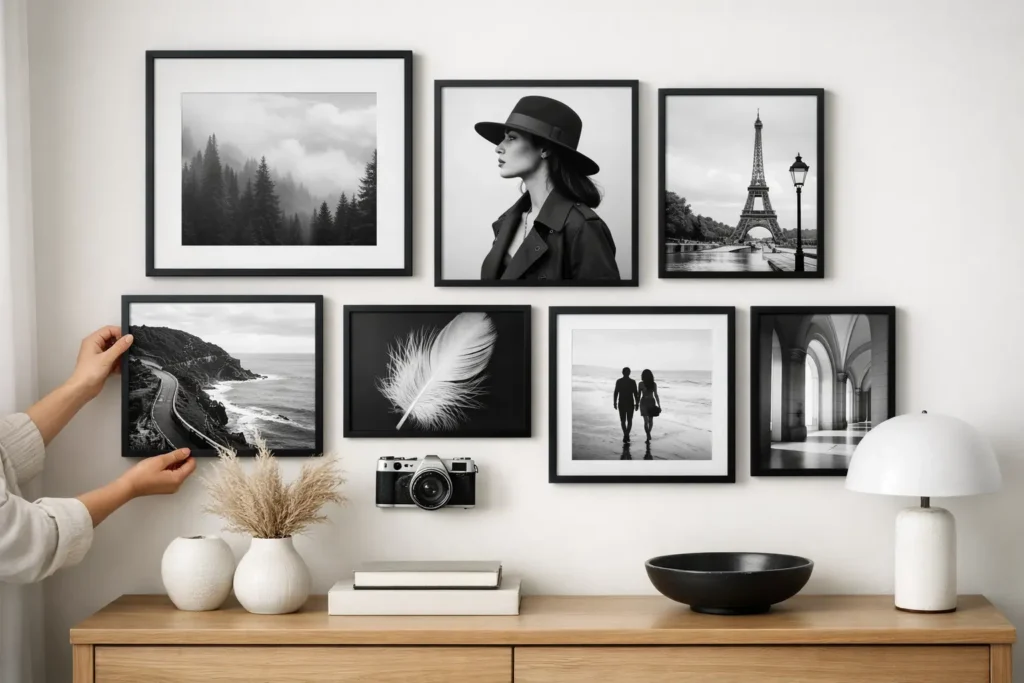
A gallery wall can either sharpen a room or clutter it. The difference usually comes down to restraint, scale, and point of view. That is exactly why black and white gallery wall prints work so well – they bring visual impact without the noise, giving you contrast, rhythm, and attitude in a format that still feels clean.
For modern interiors, black and white is not the safe option. It is the precise option. It strips away decorative filler and lets composition, subject matter, and placement do the heavy lifting. A strong monochrome wall reads as curated, architectural, and intentional, whether it hangs above a sofa, runs up a staircase, or anchors a home office.
Why black and white gallery wall prints feel so current
Color can set a mood fast, but black and white creates structure. It interacts with the room differently. Instead of competing with your rug, upholstery, or paint color, it frames the space and gives everything around it more definition.
That makes it especially effective in interiors that already carry personality – sculptural furniture, textured fabrics, concrete, oak, chrome, linen, matte black accents. In those spaces, monochrome art acts like editing. It tightens the visual language.
There is also a timeless quality to it, but timeless should not be confused with traditional. Black and white can feel classic, but in the right mix it can also feel fashion-led, conceptual, and a little severe in the best way. Think surreal portraiture beside typographic statements. Think retro forms next to stark minimal photography. The tension is what makes the wall interesting.
Start with a mood, not just a matching set
The most compelling gallery walls are rarely built from pieces that are too similar. If every print uses the same composition, the same subject, and the same tonal balance, the result can feel flat. Coordination matters, but so does contrast.
Start by deciding what kind of atmosphere you want the wall to hold. Sharp and editorial. Quiet and architectural. Surreal and slightly confrontational. Graphic and poster-driven. Once the mood is clear, choosing prints becomes easier because you are curating a point of view, not just filling rectangles.
A strong set often mixes a few visual voices. One print might be image-heavy, another text-based, another almost abstract. What connects them is not sameness. It is tension under control.
Choosing the right prints for your space
A living room gallery wall can carry more drama than a bedroom wall. A hallway often benefits from tighter repetition. A workspace can handle bolder conceptual pieces because the environment is already more functional and less soft.
This is where scale matters as much as style. In a larger room, tiny prints can disappear unless they are grouped with purpose. In a smaller apartment, oversized pieces can be brilliant, but only if the wall has enough breathing room around them. More art does not automatically mean more impact.
When selecting black and white gallery wall prints, pay attention to tonal distribution. If every piece is mostly white with fine black details, the arrangement may feel airy but underpowered. If every piece is deeply saturated with black, the wall can start to feel heavy. The best compositions usually mix light-dominant, dark-dominant, and balanced pieces so the eye keeps moving.
Layout is where the wall becomes design
Even exceptional prints can fall apart in a weak arrangement. Layout is not an afterthought. It is the difference between a wall that feels styled and one that feels improvised.
Grid layouts are clean, disciplined, and ideal for interiors with a more minimal or architectural feel. They work especially well when the frames match and the print sizes are consistent. The effect is polished and quiet, with a strong sense of order.
Salon-style layouts are more expressive. They mix sizes, sometimes orientations, and often create a looser silhouette. This format can feel more personal and layered, but it requires a better eye for spacing and proportion. Without enough control, it slips into visual clutter fast.
If you want a middle ground, anchor the arrangement with one or two larger pieces and build around them with smaller companions. This gives the wall a focal point while keeping the composition dynamic.
Before anything goes up, map it out. Lay the frames on the floor or use paper templates on the wall. Step back. Check the outer shape. The negative space between pieces should feel deliberate, not accidental.
Framing changes the entire attitude
The same print can look restrained, raw, luxurious, or gallery-sharp depending on the frame. This is not a minor detail.
Black frames create definition. They sharpen the edges and reinforce the contrast of the artwork itself. White frames can feel lighter and more minimal, especially against darker walls. Natural wood introduces warmth and softens the harder edge of monochrome, which can be useful if the room already leans cool.
There is no universal best option. It depends on the room. If your furniture is sleek and your palette is already monochrome, black frames can look strikingly editorial. If the space includes warm neutrals, boucle, oak, or plaster tones, wood may create a better balance.
Matting matters too. A mat gives the artwork more breathing room and often makes even smaller prints feel elevated. But not every piece needs one. Poster-style typography and bold conceptual works can look stronger without mats because the presentation feels more direct.
Black and white does not mean flat
One mistake people make with monochrome walls is treating them as purely graphic. The strongest gallery walls still need texture, depth, and variation.
That can come from the artwork itself – grainy photography, charcoal-like detail, hard-edged geometric forms, layered collage, distressed retro print effects. It can also come from the materials around the wall. Matte frames, glossy glass, linen curtains, plaster walls, brushed metal lighting. Black and white becomes more compelling when the surrounding surfaces add dimension.
This is also why print finish matters. A high-resolution downloadable file gives you control over the final look. Print on matte paper for a softer, more refined result. Go with a smoother, brighter stock if you want more crispness and punch. The right material can shift the same artwork from subtle to assertive.
Styling for different rooms
In the living room, the gallery wall usually acts as a visual anchor. Center it around the main furniture piece, not just the empty wall. The sofa, console, or fireplace should feel connected to the art, otherwise the arrangement can float awkwardly.
In the bedroom, black and white works best when the composition feels calm but not timid. A pair of larger prints over the bed can be more sophisticated than a crowded wall of smaller frames. If you want a fuller arrangement, keep the spacing clean and the imagery cohesive.
For a home office, this is where monochrome can really flex. Strong portraiture, graphic statements, and conceptual visuals all belong here. The space benefits from focus, and black and white delivers that without draining character.
Hallways and staircases are ideal for storytelling through repetition. Use a consistent frame style and let the artwork vary slightly in subject or density. The movement through the space will do the rest.
Why digital prints make the process smarter
A gallery wall should feel curated, not logistically exhausting. That is one reason downloadable art has become such a sharp option for design-conscious spaces. You can build the look faster, scale it to your exact wall, and print according to the room rather than forcing the room to adapt to a pre-framed format.
That flexibility matters more than people think. Maybe your entryway needs narrow vertical pieces. Maybe your office wall wants one oversized print and four smaller companions. Maybe you want to test a layout before committing to premium frames. Digital files make that process cleaner.
For a brand like 21MXM, where the aesthetic leans bold, conceptual, and high-contrast, that format makes even more sense. The artwork is designed to hit visually. Being able to print at the scale that suits your space gives the final result more authority.
There is also the practical side. No shipping delays. No waiting for stock. No compromise because the size you wanted is unavailable. For renters, frequent refreshers, and professionals styling client spaces, speed and control are part of the appeal.
The best gallery walls leave something out
A polished wall is not built by adding until every inch is covered. It is built by choosing what deserves space. That means editing hard. If one print weakens the rhythm, remove it. If the arrangement feels crowded, reduce it. If everything is equally loud, introduce one quieter piece.
Black and white gallery wall prints have a rare advantage: they already speak a disciplined visual language. Your job is to keep that discipline intact as you scale it across the wall.
When the mix is right, the room changes. It feels more intentional, more elevated, more like someone with a real eye lives there. Not decorated. Defined.
If you are building a wall worth looking at every day, choose prints with edge, give them room to breathe, and let contrast carry the mood.