
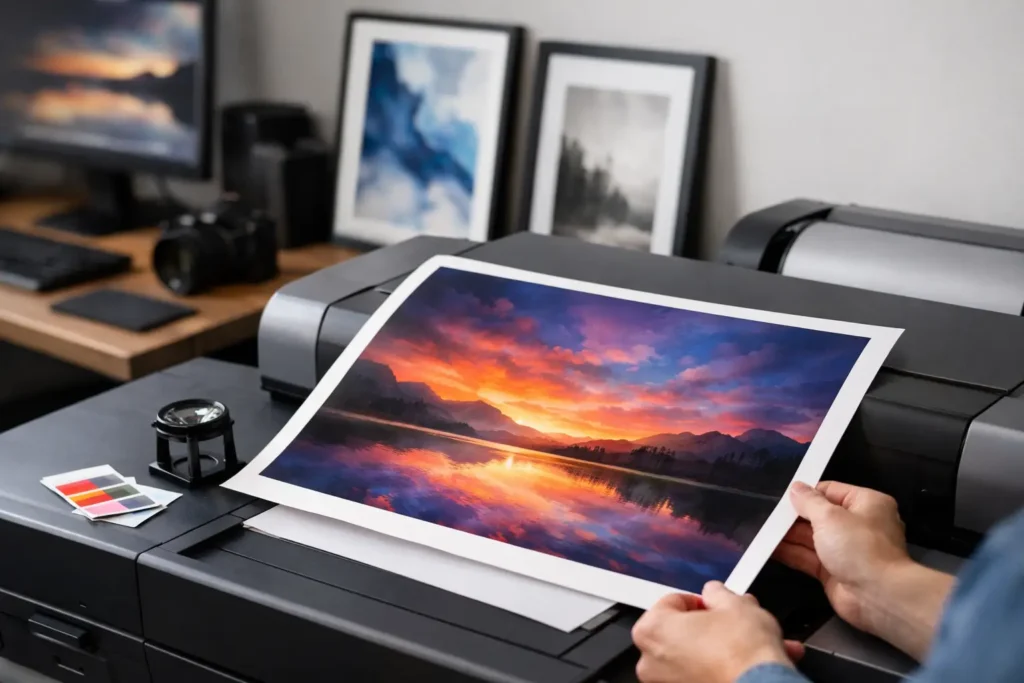
You found the piece. The mood is right, the composition hits, and the file is sitting in your inbox waiting to become part of the room. Then comes the part people underestimate – where to print digital artwork so it actually looks elevated on the wall, not flat, cheap, or off-color.
Printing is where the artwork either keeps its edge or loses it. A bold black-and-white portrait, a surreal statement poster, or a minimal conceptual piece can look gallery-clean in one format and completely ordinary in another. The right print source depends on how you want the art to live in the space, how large you want to go, and how much control you want over paper, finish, and final presence.
Where to print digital artwork depends on the room
There is no single best place for every print. A small piece for a hallway shelf, a large-format focal point over a sofa, and a polished set for a client-facing office do not need the same production path.
If the goal is speed and convenience, a local print shop or a consumer photo printer may be enough. If the artwork is design-led and you care about tonal depth, crisp contrast, and a more sophisticated finish, a fine art printer is usually the stronger choice. If you want a balance between cost, size flexibility, and decent quality, online print services sit in the middle.
That is the real answer to where to print digital artwork – not the cheapest option, not the fanciest option, but the one that matches the role the piece plays in the space.
Local print shops: fast, practical, and sometimes surprisingly good
Local print shops are often the first move for people who want artwork on the wall quickly. They are convenient, you can ask questions in person, and you may be able to see paper samples before committing. For renters, last-minute decorators, or anyone testing a layout before investing in a full wall setup, that speed matters.
The upside is control. You can often approve size, stock, and finish on the spot. If something feels wrong, there is at least a chance to catch it before the order is finalized.
The downside is consistency. Some local shops are excellent. Others are calibrated more for flyers, business signage, and standard photo output than high-impact wall art. That matters when the piece relies on rich blacks, subtle grayscale transitions, or a matte finish that feels refined instead of dull.
If you go local, ask what paper options they carry for art prints, whether they print true archival or fine art stock, and whether they can produce a borderless large-format print without softening detail. Those three answers will tell you a lot.
Online print services: the easiest middle ground
For most people, online printing services are the most balanced answer to where to print digital artwork. They are accessible, usually offer multiple sizes and materials, and can work well for standard frame dimensions. That makes styling easier, especially if you are building a clean grid wall, a diptych, or a set of coordinated statement pieces.
Online printers are especially useful if you already know what you want. You upload the file, choose the size, pick matte, gloss, or textured stock, and order without leaving the house. That suits a modern interior workflow – quick decisions, clean execution, no friction.
But convenience has a trade-off. You are trusting previews on a screen. Paper texture, black density, and finish can vary more than expected, especially between budget and premium tiers. A dramatic monochrome image can lose some of its authority if the blacks print charcoal gray or the paper reflects too much light.
If the artwork is visually minimal, subtle flaws become more visible, not less. The cleaner the design, the more every production choice shows.
Fine art printers: best for statement pieces
If the artwork is meant to anchor the room, fine art printing is usually worth it. This is where digital files start to feel intentional, not just printed. Better paper, better ink systems, better tonal range, and better handling of detail all contribute to that effect.
This option works particularly well for conceptual black-and-white work, surreal portraiture, and large statement prints where mood and contrast are doing most of the heavy lifting. Fine art printers often offer heavyweight matte papers, cotton rag, and archival options that hold depth beautifully without the glare of standard photo stock.
That said, not every room needs museum-grade output. If the print is going in a casual corner, a temporary rental, or a styling refresh you may change next season, a premium fine art service may be more than you need. The best choice is not always the most expensive one. It is the one that matches your standards for that specific wall.
Big-box office and photo retailers: acceptable, with limits
There is a reason people use chain photo labs and office stores. They are quick, familiar, and often inexpensive. For simple poster-style applications, smaller sizes, or short-term decor, they can absolutely get the job done.
Where they tend to fall short is sophistication. Paper options are often limited, blacks can print weak, and larger formats may feel more like promotional posters than interior-grade art. If your taste leans modern, minimal, and high-contrast, that difference is obvious.
This does not make them useless. It just means they are better for proofing, experimenting with scale, or decorating on a strict budget than for creating a finished designer look.
Paper matters more than most people think
A lot of the “where” question is really a “what finish should I choose” question. The same file can feel editorial, luxurious, sharp, or disappointingly basic depending on the paper.
Matte paper is usually the safest choice for modern wall art. It cuts glare, feels more architectural, and supports a clean, elevated look. This is especially true for black-and-white or minimal work where shine can interfere with the image.
Gloss and semi-gloss can work for certain retro graphics or color-heavy prints, but they are less forgiving under direct light. If the room gets strong daylight or spot lighting, reflections can fight with the artwork.
Textured fine art paper brings more depth and softness, which can look beautiful in sophisticated interiors. The trade-off is that it may slightly reduce the razor-sharp feel some graphic pieces need. Again, it depends on the artwork.
Size and resolution change the best printing option
A print that looks crisp at 11×14 may not hold the same confidence at 24×36 if the printer is not equipped for high-quality large-format output. That is why where to print digital artwork should always be decided alongside size.
For smaller formats, many decent printers can deliver solid results. Once you move into oversized statement territory, print quality becomes less forgiving. Edges, contrast, and detail all need to stay clean from a distance and up close.
If you are printing large, ask for the recommended maximum size for the file and avoid stretching beyond it just because the wall can take it. Bigger is not better if clarity suffers. A slightly smaller print with strong presence always wins over a larger one that looks soft.
Framing plans should guide your print choice
Print first, frame second sounds logical, but framing should shape the decision from the start. If you plan to use a standard frame, choose a common print size. It saves money and makes the entire process easier.
If you want a more custom, gallery-style look with oversized matting or a dramatic float frame, then investing in better paper and a stronger print source makes more sense. Premium framing exposes every detail. A mediocre print inside an expensive frame rarely fools anyone.
This is where downloadable art has a real advantage. You can choose the scale, crop approach, and final presentation around your room instead of forcing your room to fit pre-made decor.
A smart way to choose
If you are unsure, start by asking three questions. Is this piece a focal point or a supporting accent? Am I printing it small, medium, or oversized? Do I care more about convenience, cost, or finish?
If convenience leads, use a good online printer or local shop. If finish leads, go fine art. If cost leads, use a basic printer for the first version and upgrade later if the piece earns a permanent place in the room.
For design-conscious spaces, that flexibility is everything. You are not just filling a blank wall. You are shaping atmosphere. Bold artwork deserves printing that respects the image, the scale, and the room it is entering.
A strong digital file already gives you freedom. The smart move is using that freedom with intention. If you want the print to feel crisp, modern, and visually commanding, choose the printer the same way you choose the art – with taste, not guesswork. Brands like 21MXM are built for that kind of visual control, and the final print should carry the same energy once it hits the wall.