
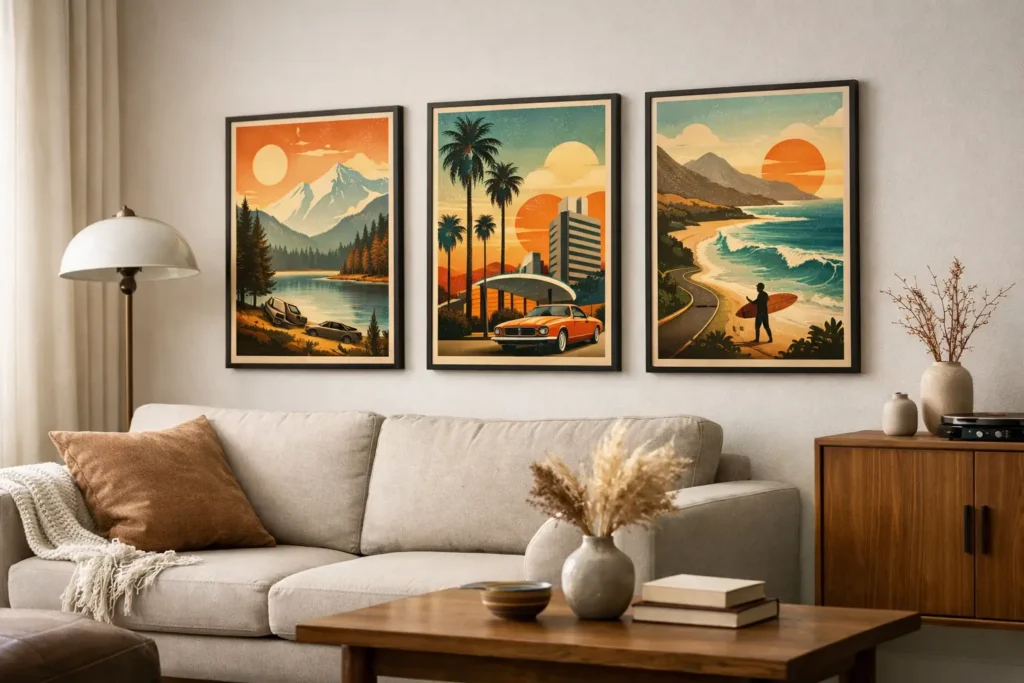
Some living rooms feel finished the second you walk in. Not because they are packed with furniture or layered with expensive decor, but because the walls say something. Retro poster prints for living room spaces do exactly that. They bring graphic energy, cultural texture, and a point of view that feels collected rather than generic.
The appeal is obvious. Retro design carries memory, but it also carries shape, color, and attitude. A strong poster print can pull a room out of safe territory and give it a sharper identity. In a modern interior, that tension matters. Clean lines and minimal furniture can look sophisticated, but without art, they can also feel flat. Retro posters introduce warmth, movement, and personality without sacrificing visual control.
Why retro poster prints for living room walls work so well
A living room usually has to do too much. It hosts guests, absorbs daily routines, and acts as the visual center of the home. That makes wall art less of an accessory and more of a structural decision. Retro poster prints work because they deliver impact fast.
They tend to be graphic by nature. Think bold typography, cinematic compositions, faded palettes, saturated reds, mustard yellows, deep blues, or black-and-white contrast with a vintage edge. These elements read clearly from across the room, which matters in larger open-plan spaces where subtle artwork can disappear.
They also bridge styles surprisingly well. A mid-century console and a 1970s-inspired print are an easy pairing, but retro posters also look striking in rooms that lean minimal, industrial, or contemporary. That mix of old references and modern styling creates the kind of tension that makes a space feel curated rather than theme-driven.
The key is restraint. A retro print should feel intentional, not nostalgic for nostalgia’s sake. The strongest rooms use vintage-coded artwork as a design accent, not a costume.
The difference between retro and simply dated
Not every old-looking poster deserves wall space. There is a difference between retro style and artwork that makes a room feel stuck.
Good retro art has design intelligence. The composition is clean. The typography feels deliberate. The palette works with the room instead of fighting it. Even when the image references another era, the print still feels visually relevant. That is what gives it longevity.
Dated art, on the other hand, often leans too literal. Overly kitsch slogans, washed-out novelty graphics, or low-quality reproductions can cheapen the room. If the piece reads more like a prop than a statement, it usually weakens the overall look.
A better approach is to choose retro poster prints with strong form. Film-inspired graphics, travel posters, abstract vintage layouts, surreal portraiture, and conceptual black-and-white works with a retro edge all hold up beautifully. They carry history, but they also carry presence.
How to choose the right retro poster prints for living room layout
Scale comes first. If you place a small print above a long sofa, it will look hesitant. If you place a massive, detail-heavy poster in a tight corner, it can overwhelm the room. The print needs to match the architecture around it.
Above a sofa, one oversized statement poster often looks more confident than several smaller pieces. It creates a gallery-like focal point and gives the room a strong visual anchor. If you prefer a pair or trio, keep the spacing tight and the theme coherent so the grouping reads as one composition.
If your living room has tall ceilings, vertical retro posters can emphasize height and make the room feel more editorial. In a wider space, horizontal pieces or balanced diptychs tend to feel calmer and more architectural.
Color matters just as much as scale. If the room already has strong furniture tones, choose retro art that echoes one or two of them rather than introducing five new directions. A burnt orange detail in the print can connect beautifully with walnut wood, cognac leather, or cream upholstery. If your room is mostly monochrome, a vintage-inspired poster with saturated color can act as the element that wakes everything up.
There is also the question of mood. A retro travel print feels airy and escapist. A bold typographic piece feels urban and sharp. A surreal portrait feels more provocative. None is universally better. It depends on whether you want the room to feel relaxed, cinematic, intellectual, or slightly rebellious.
Framed, unframed, glossy, matte – what changes the look
Printing choices shape the final result more than many people expect. A retro poster can lean polished or raw depending on the material and finish.
A thin black frame gives most retro pieces a cleaner, more contemporary edge. Natural wood warms them up and works especially well if the room already includes organic textures. White frames can look crisp, but they are best in bright rooms where you want a lighter, more gallery-style presentation.
Matte paper usually suits retro graphics better than glossy finishes. It softens reflections and gives the artwork a more elevated feel. Gloss can work for pop-heavy or high-saturation poster styles, but it can also push the piece toward a commercial look if the print quality is not excellent.
This is where digital art has a real advantage. You are not locked into one size, one frame, or one finish. You can scale the piece for your wall, choose the paper stock that matches your interior, and print locally with much more control over the final look. For style-focused spaces, that flexibility matters.
Styling retro posters in a modern living room
The easiest mistake is overcommitting. If every object in the room references the same decade, the space can feel staged. A stronger room mixes retro poster art with furniture and materials that keep the look current.
Let the poster carry the vintage reference while the room stays edited. A sleek cream sofa, a sculptural coffee table, smoked glass, black metal, and one graphic retro print create a much sharper result than a full set of nostalgic accessories.
Contrast is your friend. If the poster is colorful, keep the surrounding decor quieter. If the artwork is black and white, use it to intensify a room built around texture – bouclé, linen, wood grain, matte ceramics. If the print has heavy typography or busy composition, give it negative space around the frame so it can breathe.
Layering also works, especially for renters or anyone who prefers a more casual, fashion-led look. A large retro poster leaned on a console behind a lamp or stacked with a second print can feel effortless in the right room. The catch is proportion. Too many overlapping pieces and the effect turns cluttered fast.
Gallery wall or one statement piece?
Both can work, but they create different kinds of energy.
One oversized retro poster feels confident, clean, and architectural. It is ideal if the room already has strong furniture silhouettes or if you want the art to read as a single statement. This approach often suits more minimal interiors.
A gallery wall feels more personal and layered. It works best when the posters share some visual logic, whether that is palette, era, line quality, or framing style. The risk is inconsistency. If the pieces compete too hard, the wall loses impact.
If you go with a gallery wall, vary scale but keep the spacing disciplined. Treat it like composition, not accumulation.
What makes a retro print feel premium
Quality changes everything. The same design can look elevated or disposable depending on resolution, print sharpness, and the care taken in presentation.
A premium retro poster should have enough detail to hold its own at larger sizes. Colors should feel intentional, not muddy. Blacks should read deep and clean. Edges should stay crisp. Even distressed or faded designs need control. There is a difference between a vintage effect and poor production.
That is one reason downloadable high-resolution art has become such a smart choice for modern interiors. It gives buyers immediate access to statement work without waiting for shipping or settling for preset dimensions. Brands like 21MXM lean into that freedom – bold visual language, flexible sizing, and artwork that feels more design-led than decorative.
For people who care about interiors, convenience alone is not enough. The art still needs presence. It needs to feel deliberate on the wall. When the file quality is strong and the styling is right, digital prints can deliver that gallery-inspired effect with far more control.
The smartest way to make retro feel current
The best retro rooms do not imitate the past. They edit it.
Choose poster prints with shape, contrast, and cultural edge. Let them interact with modern furniture, clean framing, and breathing room. Think less themed, more curated. Less novelty, more visual authority.
A living room should reveal taste before anyone asks about it. Retro poster prints do that when they are chosen with precision. They bring memory, yes, but also mood, sophistication, and a little tension. And that tension is often what makes a room worth looking at twice.
If your walls feel polite, this is the fix: pick the print that changes the temperature of the room, then give it the scale and presentation it deserves.