
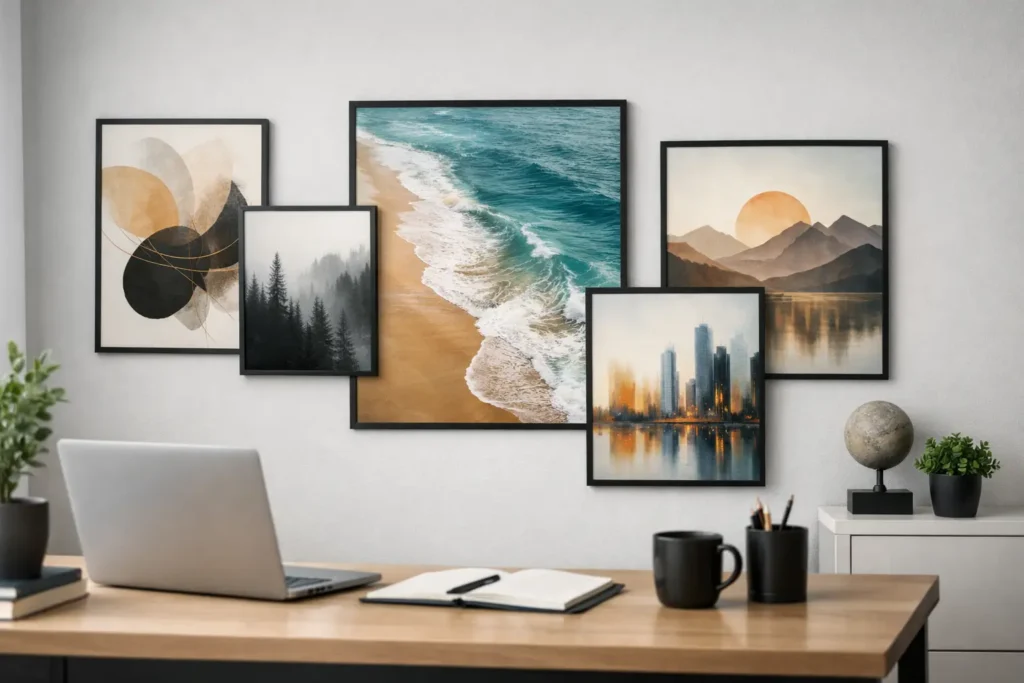
A blank office wall says more than most people realize. It can read sterile, temporary, even slightly disengaged. The best art prints for offices do the opposite. They create visual authority, shape the mood of the room, and make the space feel considered rather than assembled.
That matters whether you work from a spare bedroom, lead meetings in a private studio, or style a client-facing office that needs to look sharp on sight. Office art is not filler. It is part of the brand language of the space. The right print can make a room feel more focused, more elevated, and more expensive without changing a single piece of furniture.
What makes the best art prints for offices?
The short answer is clarity. Office art works best when it feels intentional from across the room and interesting up close. It should support concentration, not compete with it. That usually means strong composition, controlled color, and enough personality to avoid the forgettable corporate look.
Scale matters just as much as style. A tiny print over a wide desk looks apologetic. An oversized piece in a compact room can feel oppressive. The best office walls have proportion. They give the art enough room to speak, then let it hold the space.
Material flexibility also matters more than people think. Downloadable high-resolution prints have a real advantage here because they let you adapt the piece to the room instead of forcing the room to adapt to a standard product size. You can print large for impact, keep it compact for a niche wall, or create a grid for a more curated look.
1. Conceptual black-and-white prints
If there is one category that consistently performs in modern workspaces, it is conceptual black-and-white art. These pieces feel intelligent, architectural, and composed. They bring contrast without visual noise and give an office a sharper, more editorial atmosphere.
This style works especially well in minimalist interiors, executive offices, and creative spaces with clean lines. It also solves a common design problem: how to add impact without introducing colors that clash with branding, furniture, or flooring. Black and white is strict in the best way. It frames the room.
The trade-off is mood. If the rest of the office already feels cold, a monochrome print can push it too far. In that case, choose a black-and-white piece with texture, surreal form, or expressive typography so the room still feels human.
2. Surreal portraits with attitude
Portraiture can be risky in offices because generic figurative work often feels decorative rather than directional. Surreal portraits avoid that trap. They feel art-led, contemporary, and slightly provocative, which is exactly why they work in spaces that need identity.
A strong portrait print can anchor a reception area, energize a creative studio, or give a home office a point of view. It suggests taste. It holds attention. It creates the kind of room people remember after the meeting ends.
This category is best for brand-forward businesses, founders, designers, and anyone whose office doubles as a visual extension of personal style. If your work is more conservative, keep the framing sleek and the palette restrained so the piece feels refined rather than theatrical.
3. Retro posters for energy and character
Retro art prints bring movement to an office. They tend to carry stronger color, bolder typography, and a more playful graphic rhythm than purely minimalist work. That makes them useful in rooms that need life, especially offices with neutral furniture and limited architectural character.
Used well, retro posters feel curated rather than nostalgic. Think graphic confidence, not diner-wall kitsch. In startup offices, collaborative spaces, and creative home setups, they can soften the formality of the room while still looking design-conscious.
The only caution is consistency. One retro piece can look striking. Three unrelated ones can make the office feel visually scattered. If you go this route, keep a clear thread between prints, whether that is color, era, or composition.
4. Minimal abstract prints
Abstract art has a place in almost every office, but not all abstract art works equally well. The strongest options are structured, restrained, and bold enough to hold their own. Loose, vague pieces often disappear into the background. Graphic abstracts with a clear sense of tension and balance tend to perform better.
These prints are ideal when you want sophistication without a literal subject. They fit executive spaces, design studios, therapy offices, and home workspaces because they can adapt to different moods. Some feel calm. Others feel charged. The key is choosing abstraction with backbone.
If your office already has a lot of pattern, shelving, or visible equipment, minimal abstract prints can restore order. They give the eye a place to land.
5. Statement typography and text-based art
Some offices need artwork that speaks directly. Statement typography does that with precision. A well-designed text print can bring edge, confidence, or wit to a space without slipping into motivational-poster territory.
This category works best when the typography itself is the art, not just the message. Strong type hierarchy, intentional spacing, and a fashion-aware palette make all the difference. In creative offices, these prints can sharpen the room instantly. In home offices, they can add structure to a small wall where a large image might feel too heavy.
What to avoid is the obvious. Generic affirmations tend to flatten a room. Choose words that feel curated, not recycled.
6. Architectural and geometric compositions
Geometric prints bring discipline to a workspace. Clean lines, repeated forms, and architectural references naturally suit environments built around focus and order. They are especially effective in offices with modern desks, metal accents, glass, or monochrome palettes.
These pieces tend to read as polished and professional, which makes them a smart choice for consulting spaces, law offices, and high-end client-facing rooms. They create structure without becoming severe, especially when paired with warm wood, matte frames, or soft textiles.
If the room feels too rigid, balance geometry with one softer element nearby, such as a textured rug, a curved chair, or a plant. Good office styling is often about contrast.
7. Large-scale single prints
Sometimes the best move is not a gallery wall or a layered composition. It is one commanding print, scaled correctly, centered with confidence, and allowed to dominate. Large-format art creates authority fast. It can turn an average office into a finished space in one move.
This approach works particularly well behind a desk, in a conference room, or on the main wall visible from the doorway. A bold black-and-white piece, a surreal portrait, or a striking abstract can all carry this format.
The advantage is impact. The downside is pressure. When you choose one large print, it has to be the right one. There is nowhere for a weak image to hide.
8. Curated sets and diptychs
If one oversized piece feels too singular, a set of two or three coordinated prints can create a more layered result. Diptychs and triptychs work well in long office layouts, above credenzas, or in shared workspaces where one image might feel too concentrated.
This is also where downloadable art is especially practical. You can control spacing, sizing, and orientation based on the wall rather than trying to force a pre-made frame set into the room. For modern offices, sets with a consistent visual language look far more elevated than mixed prints with no relationship to one another.
A good set should feel connected but not repetitive. Think visual tension, not copy and paste.
How to choose the best art prints for your office style
Start with the role the room needs to play. A private office can carry more mood and personality. A client-facing office usually needs polish first, then expression. A home office often needs both because it has to support concentration while still feeling like part of your life.
Next, look at the room’s existing visual weight. If your furniture is minimal, the art can be bolder. If the office already has strong materials, shelving, books, or color, choose prints with cleaner composition. Great styling is rarely about adding more. It is about adding the right contrast.
Then think about how the art will be seen. On video calls, the wall behind you needs a crisp silhouette and enough scale to register on screen. In a reception area, the piece should work from a distance. In a personal workspace, you can afford more nuance because the viewing distance is closer.
Why print flexibility matters in office design
Office walls are rarely standard. There is the awkward wall between windows, the narrow strip beside a cabinet, the oversized wall that swallows small frames whole. That is why flexible, high-resolution digital art makes so much sense for workspaces.
You can print to the exact size the room needs, choose paper or canvas based on the finish you want, and frame the piece in a way that suits the interior rather than settling for whatever comes ready-made. For design-conscious professionals, that level of control matters. It turns wall art into a styling decision instead of an afterthought.
For a brand like 21MXM, that flexibility aligns naturally with a more curated approach to interiors. You get the immediacy of instant access, but the result can still feel custom, sharp, and gallery-aware.
The best office art does not beg for attention. It sets the tone, raises the standard, and makes the whole room feel more deliberate. Choose prints with presence, give them the scale they deserve, and let the walls work as hard as the rest of the space.