
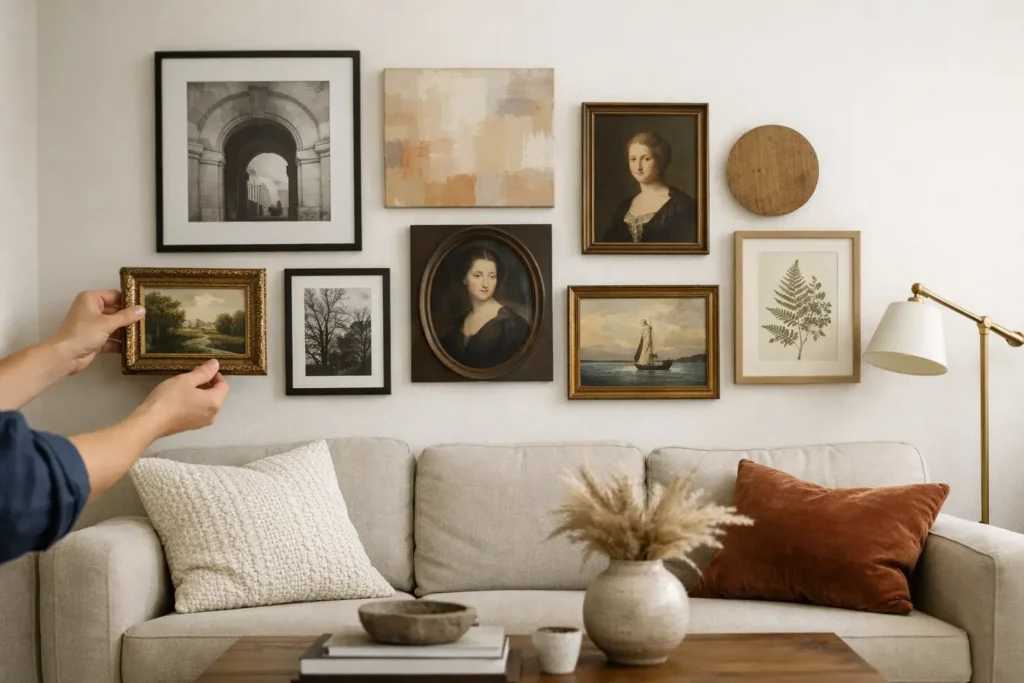
A gallery wall can make a room look styled in five minutes – or chaotic for the next five years. The difference is rarely budget. It is composition. If you want to know how to build gallery walls that look intentional instead of improvised, start by thinking like a curator, not just a shopper.
The strongest gallery walls do more than fill blank space. They set the tone of the room, sharpen its identity, and create a focal point with real presence. In a minimal interior, they add edge. In a softer space, they bring contrast. In a professional setting, they signal taste without trying too hard.
How to build gallery walls with a clear point of view
Before you choose frames or start hammering nails, decide what the wall is supposed to say. This is where most people lose the plot. They collect pieces they like individually, then wonder why the finished wall feels random.
A gallery wall needs a visual thesis. Maybe it is monochrome and conceptual. Maybe it is retro and graphic. Maybe it revolves around surreal portraits with a cinematic mood. The exact style can vary, but the attitude should stay consistent.
That does not mean every piece has to match perfectly. In fact, too much sameness can flatten the effect. What you want is cohesion with tension. A shared color story, repeated shape language, or a consistent emotional tone creates structure. One or two pieces that disrupt the pattern keep it interesting.
If your room already has a strong design language, use that as your starting point. A gallery wall above a sleek black console should not suddenly turn cottagecore. A clean loft with concrete, glass, and steel can handle bolder, sharper work. The wall should feel connected to the architecture around it.
Start with placement, not prints
One of the smartest ways to build gallery walls is to treat the surrounding furniture as part of the composition. The wall does not float on its own. It interacts with the sofa, bed, desk, dining table, or hallway below it.
If you are hanging art above furniture, the arrangement should generally span about two-thirds to three-quarters of the furniture width. Smaller than that, and it can look timid. Wider than that, and it starts to feel disconnected. The center of the grouping should usually land around eye level, but this shifts depending on ceiling height and the function of the room.
A gallery wall in a dining area can sit slightly lower to feel intimate. In a hallway, you may want a tighter vertical rhythm because people experience it in motion. Above a bed, the composition should feel anchored and calm rather than overly scattered.
This is also where scale matters. Large walls need breathing room and larger pieces. Tiny prints sprinkled across a big expanse often read as indecisive. If the wall is substantial, use at least one or two works with enough visual weight to hold it.
Choose a layout style before you hang anything
There is no single right layout, but there is always a right layout for the space. Symmetrical grids feel polished, controlled, and architectural. Organic salon-style arrangements feel layered, expressive, and more collected. Linear arrangements are excellent in narrow spaces, over sideboards, or along staircases.
If your room already leans minimal, a structured layout usually looks stronger. Think evenly spaced frames, repeated dimensions, and a clear outer shape. If the room has more texture and personality, a looser arrangement can work beautifully, especially when the artwork shares a clear palette or theme.
A useful test is to define the outer boundary first. Even if the inside arrangement is asymmetrical, the total shape should still make sense. Square, rectangle, or a controlled vertical column – these give the eye something to read. Random edges are usually what make gallery walls feel messy.
How to build gallery walls that feel balanced
Balance is not the same as symmetry. A gallery wall can be asymmetrical and still feel composed if the visual weight is distributed well.
Dark, high-contrast pieces tend to feel heavier than pale, airy ones. Large frames pull more attention than small ones. Thick black frames create more structure than thin natural wood. A single bold artwork can offset several smaller pieces if it has enough presence.
This is why planning on the floor first matters. Lay out every piece and look at the composition from above. Step back. Squint. If one side feels dense and the other side feels weak, adjust. Move your boldest piece slightly off center if needed, then build around it.
Spacing is where the whole thing either sharpens up or falls apart. Keep the gaps consistent, usually around 2 to 3 inches for smaller walls and 3 to 4 inches for larger ones. Wider spacing can feel more editorial and luxurious, but only if the pieces are large enough to support it. Tight spacing creates energy, though too tight can feel cramped.
Mix sizes with intention
The best gallery walls almost always combine scales. If every frame is the same size, the result can feel predictable unless you are deliberately creating a grid. If every frame is different, the wall can drift into visual noise.
A more convincing approach is to choose a hierarchy. Start with one anchor piece, add two to four supporting works, then fill with smaller pieces if the concept calls for it. The anchor does not have to sit dead center, but it should establish the wall’s gravity.
This is also where downloadable art has a clear advantage. You can test different print sizes before committing. A piece that looks understated at 8×10 can become the hero at 24×36. That flexibility gives you more control over proportion and lets you shape the wall around the room instead of forcing the room to adapt to standard retail sizing.
Frames matter more than people think
Frames are not an afterthought. They are part of the design language.
Black frames create contrast, discipline, and a more contemporary edge. White frames feel lighter and quieter, though they can disappear on pale walls. Natural wood softens the look and works well when you want warmth without losing minimalism. Mixed frames can work, but only when there is a clear logic behind them. Without that, the wall starts to look accidental.
If your artwork is bold, consistent framing helps control the energy. If the art is subtle, stronger framing can add definition. Matting is another lever. Wide mats make pieces feel more elevated and gallery-like, while full-bleed framing can feel sharper and more graphic.
It depends on the mood you want. Clean and architectural. Moody and dramatic. Relaxed but refined. The frame should reinforce that mood, not compete with it.
Build color tension, not color chaos
A gallery wall does not need to match the room exactly. In many cases, it should not. Perfect coordination can look flat. What you want is a relationship.
If the room is neutral, black-and-white artwork can bring a sophisticated hit of contrast. If the space already has strong color, the wall can either echo one or two tones or deliberately cut through them with monochrome pieces. Both approaches work. The key is restraint.
Too many unrelated colors create noise fast, especially across multiple frames. Repeating one accent color in small ways can pull very different artworks together. So can sticking to a narrow tonal range and letting subject matter vary.
For modern interiors, conceptual black-and-white art, surreal portraiture, and strong graphic posters often work because they add identity without relying on decorative filler. They read as confident. More edited. Less disposable.
The biggest mistakes to avoid
Most bad gallery walls fail for familiar reasons. The art is too small for the wall. The spacing changes from piece to piece. The arrangement ignores the furniture below it. Or the collection has no common thread beyond being available.
Another common issue is overfilling. Not every blank section needs a frame. Negative space is part of the composition. It gives the eye a pause and makes the artwork feel more expensive.
And then there is the habit of buying everything pre-framed in fixed sizes, then trying to make it all work afterward. That is design in reverse. A better approach is to define the wall first, then choose art and print sizes that serve the composition. Brands like 21MXM fit naturally into that process because the artwork can be printed to suit your exact layout rather than forcing your layout to fit the art.
Treat the wall like a finished composition
Once the wall is hung, stop and style the room around it. Pull one tone from the artwork into a cushion, rug, ceramic object, or lamp. Echo a shape. Repeat a texture. These small links make the gallery wall feel integrated rather than applied.
Then give it space to do its job. A strong gallery wall should carry presence on its own. It does not need a shelf crammed with decor, or a dozen competing objects fighting for attention below it.
The real trick in how to build gallery walls is knowing when to edit. More art is not always better. Better art, better scale, better placement – that is what creates a wall with impact. When the composition feels sharp, the room changes with it. Not louder. Just more certain.