
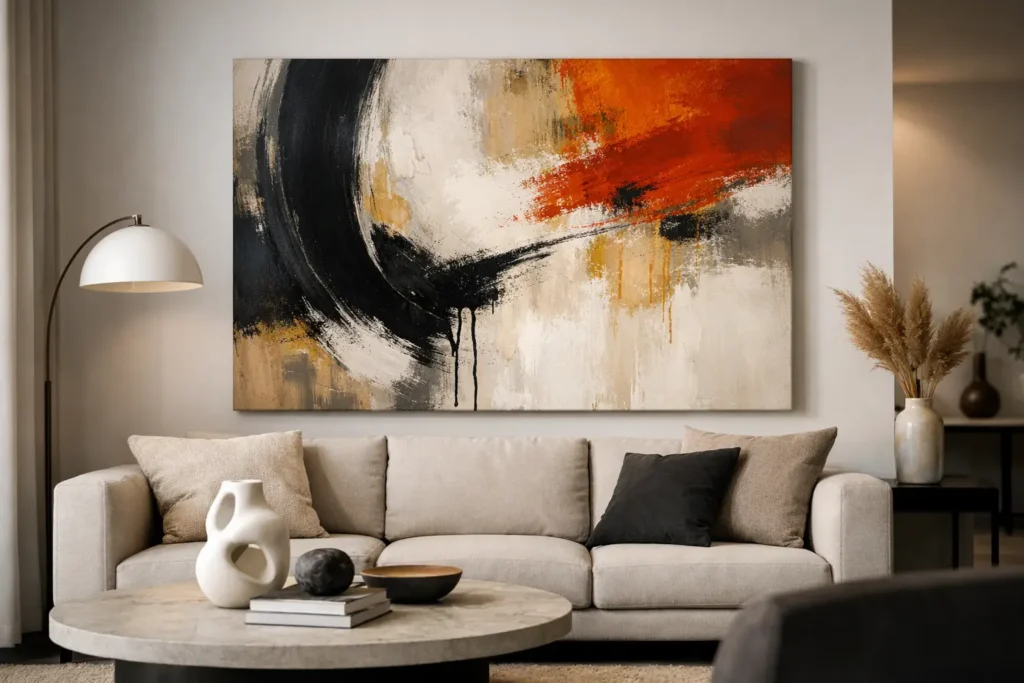
A blank wall can make even a well-furnished room feel unfinished. Not empty – unfinished. The difference usually comes down to presence, and that is exactly where statement art for modern interiors earns its place. It does more than fill space. It sets the tone, sharpens the room’s point of view, and gives the entire interior a stronger visual identity.
In modern spaces, that role matters more. Clean lines, restrained palettes, and edited furniture can look sophisticated, but they can also drift into flatness if there is nothing to interrupt the calm. Statement art brings contrast, tension, and atmosphere. It gives minimal interiors a pulse.
What statement art really does in a modern room
The phrase gets overused, but true statement art is not just large art. Size helps, but scale alone is not enough. A piece becomes a statement when it changes how the room feels the moment you notice it.
Sometimes that happens through contrast – a stark black-and-white portrait against soft neutral walls. Sometimes it happens through concept – an image that feels surreal, graphic, or emotionally charged. Sometimes it is simply confidence. The artwork does not apologize for being there, and the room gets stronger because of it.
That is why modern interiors respond so well to pieces with a clear point of view. Sleek furniture and minimal styling create room for impact. One bold print can do what five polite accessories never will.
Why statement art for modern interiors feels so current
Modern decorating has moved away from generic filler. People want rooms that feel edited, not staged. They want visual choices that say something about taste, mood, and identity. Art is one of the fastest ways to create that effect because it reads instantly.
A strong print can make a rental feel custom. It can make a home office feel intentional instead of improvised. It can pull a living room out of that familiar cycle of beige sofa, textured rug, coffee table, done. Art introduces character without asking you to renovate.
There is also a practical reason this approach has traction right now. People want flexibility. They want to choose the size, framing style, and finish that suits their space instead of forcing a room to fit a pre-made object. That freedom is especially valuable with downloadable art, where the image stays consistent but the presentation can shift from apartment-scale to oversized drama.
The visual traits that make a piece feel like a statement
Not every bold piece works in every room, but statement art usually shares a few qualities. It has clarity. It has intention. And it holds attention even in a restrained setting.
High contrast is one of the most effective tools. Black-and-white works so well in modern interiors because it creates instant structure. It cuts through soft furnishings, neutral paint, and natural materials with precision. The effect is clean, graphic, and architectural.
Subject matter matters too. Conceptual imagery, surreal portraiture, retro poster influences, and fashion-aware compositions all bring a sharper attitude than generic landscapes or vague abstracts. That does not mean subtle work cannot be powerful. It means the piece needs a distinct visual language.
Scale is the final ingredient, but it depends on the wall. In some spaces, one oversized print is the strongest move. In others, a tightly curated pair or triptych creates more rhythm. The key is that the art should feel deliberate, not scattered.
How to choose statement art for modern interiors
Start with the room’s architecture and furniture, not just your favorite image on a screen. A room with low furniture and wide wall space can support larger, more horizontal work. A narrow hallway or compact office may need a vertical piece with a strong silhouette. Good styling starts with proportion.
Then think about mood. Do you want the space to feel calm but sharp, dramatic and moody, or playful with edge? Modern interiors are not one-note. A monochrome portrait can bring sophistication and tension. A retro graphic print can inject energy. A surreal image can make the room feel more layered and personal.
Color discipline helps. In a neutral room, black-and-white statement art often lands hardest because it creates contrast without adding visual clutter. In a room that already has strong materials or accent colors, a more restrained print may be the smarter choice. The goal is not competition. The goal is balance with bite.
This is also where personal taste should overrule trends. If a piece looks fashionable but says nothing to you, it will fade into the background faster than you expect. Statement art should feel like an extension of your eye, not a styling obligation.
Placement matters as much as the print
Even exceptional art loses impact when placement is off. Hang it too high and it disconnects from the furniture. Go too small on a major wall and the room starts to feel timid. Crowd it with too many objects and the art has no room to breathe.
In a living room, the piece above a sofa should feel anchored to the furniture below it. In a bedroom, art above the bed should create presence without making the wall feel heavy. In a dining area, bold work can shift the entire mood of the room because it sits in your line of sight longer. Offices are often the easiest place to go stronger, especially if the goal is to make the space feel creative, focused, and elevated.
Negative space matters in modern interiors. Let the piece own its wall. Statement art gets its power from contrast, and that includes contrast with emptiness.
Framing, scale, and finish change the outcome
This is where many good choices become great ones. The same artwork can feel refined, raw, minimal, or more decorative depending on how it is printed and framed.
A thin black frame keeps the look crisp and architectural. A white border can add gallery-style breathing room. Printing larger than you first planned often creates the confidence modern interiors need, especially in rooms with higher ceilings or open-plan layouts.
There are trade-offs. Oversized art looks dramatic, but it demands precision in placement and can overwhelm a compact room if the margins are too tight. Frameless or poster-style presentation can feel more casual and current, but it may not give enough structure in a polished formal space. There is no single right answer. It depends on the room, the artwork, and the level of finish you want.
That flexibility is one reason digital art has become such a smart option for design-conscious spaces. You can choose the exact dimensions, material, and frame profile that serve the room instead of compromising around a fixed format. For a brand like 21MXM, that makes the art feel less like a product and more like a styling tool with real range.
Common mistakes that flatten the effect
The first is playing it too safe. Many rooms miss their moment because the art is pleasant but forgettable. Modern interiors can handle more edge than people think.
The second is forcing a match. Art does not need to repeat the rug color or echo every finish in the room. In fact, overly coordinated spaces often feel less sophisticated. A little friction creates interest.
The third is treating every wall equally. Not every surface needs art, and not every room needs the same intensity. One commanding piece in the right place often has more impact than a house full of smaller, disconnected prints.
The last mistake is ignoring print quality. If the image lacks depth, resolution, or tonal richness, the room will feel cheaper no matter how good the concept is. Statement art needs visual authority, and that comes from both design and execution.
The rooms where statement art changes everything
Living rooms are the obvious stage, but they are not the only one. Entryways benefit from immediate impact. A strong piece near the front door tells people exactly what kind of space they are entering.
Bedrooms become more sophisticated with art that adds mood rather than sweetness. Home offices become less functional and more editorial. Hallways, often treated as afterthoughts, can become some of the most memorable spaces in the home when the artwork is confident enough.
Professional interiors benefit just as much. Waiting areas, studio spaces, boutique offices, and client-facing rooms all rely on atmosphere. Strong art signals taste, clarity, and intention before anyone says a word.
Statement art works best when it is allowed to be specific. Not broad. Not generic. Specific. The room does not need more decoration. It needs a visual decision with real conviction.
Choose the piece that shifts the air in the room. Then give it the scale, placement, and finish to do its job properly. That is when a wall stops being background and starts becoming part of the identity of the space.