
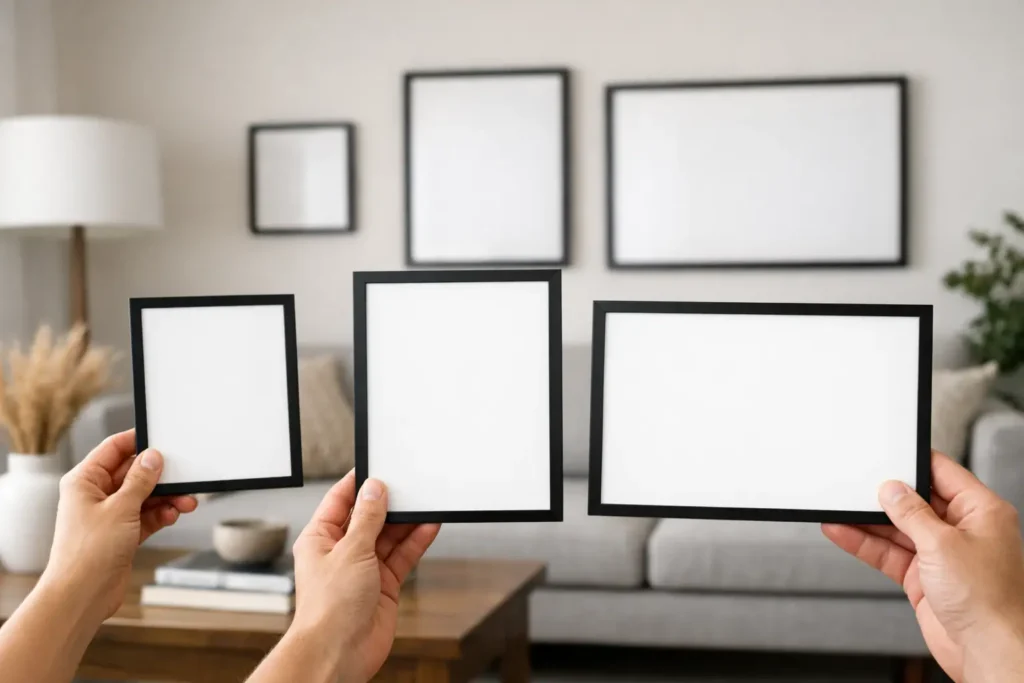
A print that looked perfect on your screen can feel oddly small once it hits the wall. That is usually not an art problem. It is a scale problem. If you are figuring out how to choose print sizes, the real goal is not just making something fit. It is making the piece feel intentional in the room – sharp, balanced, and strong enough to hold visual weight.
In modern interiors, scale does a lot of the talking. A bold black-and-white portrait in the wrong size loses its authority. A surreal statement poster printed too small can disappear into the background. The right size gives the artwork presence. It changes the mood of the room before anyone even registers the subject.
How to choose print sizes without guessing
Most people start with the print itself. Start with the wall instead. Art should relate to the architecture, furniture, and negative space around it. A piece can be beautifully designed and still look misplaced if the proportions are off.
The easiest rule is to let the wall and the furniture set the boundaries. If you are hanging art above a sofa, console, bed, or desk, aim for the artwork to span about two-thirds to three-quarters of the furniture width. So if your sofa is 90 inches wide, your total art width should usually land somewhere around 60 to 68 inches. That can be one oversized print or a grouped arrangement.
If the wall is empty and not anchored by furniture, think in terms of visual mass. A large blank wall needs a larger gesture. Small prints on a wide wall can look timid unless they are intentionally grouped into a gallery arrangement with enough total width and height to command the space.
Start with the room, not the file
Every room has its own tolerance for scale. A bedroom can handle softness, but it still needs proportion. A living room usually wants more impact because the wall is seen from a greater distance. A hallway or entry can support narrower formats because the viewing angle is more transitional.
Ceiling height matters too. In rooms with standard 8-foot ceilings, oversized vertical prints can create elegance, but they need breathing room. In rooms with taller ceilings, smaller art often looks lost unless it is layered with furniture, lighting, or additional pieces.
This is where downloadable art becomes a smarter option. You are not locked into one manufacturer-defined size. You can choose the scale that fits the room instead of forcing the room to adapt to the print.
Small walls
For compact spaces like powder rooms, narrow hallways, reading corners, and apartment nooks, prints around 8×10, 11×14, and 12×16 can work beautifully. The key is context. A single 8×10 on a broad wall will usually feel underpowered, but the same print on a narrow strip of wall between a doorway and a shelf can feel precise and refined.
Medium walls
This is where many homes live. Dining areas, bedrooms, small offices, and apartment living rooms often suit sizes like 16×20, 18×24, and 20×28. These dimensions have enough presence to read clearly without overwhelming the room.
If your style leans minimal, medium sizes are often the sweet spot. They let a striking image hold focus while keeping the overall room clean and controlled.
Large walls
For major focal points – above a sofa, over a king bed, in a dining room, or behind a reception desk – look at 24×36, 28×40, and 30×40 and beyond. This is where statement art starts to perform the way it should. Bold, contemporary work needs room to breathe. Scale gives it drama.
Large prints are especially effective with conceptual black-and-white pieces, retro posters, and portraits with strong contrast. The details open up. The mood gets stronger. The wall stops looking like an afterthought.
Match the print size to the job it needs to do
Not every artwork needs to dominate. Some pieces are meant to punctuate a room. Others are meant to define it.
If the art is your main focal point, go larger than feels safe at first. People usually print too small because they are thinking about the file on a screen or the dimensions in isolation. On the wall, scale shrinks visually. What feels large in theory often feels just right once installed.
If the print is supporting other elements – say, layered above a bar cart, beside shelving, or within a styled bedroom wall – you have more freedom to stay moderate. In these cases, the print should connect with the rest of the composition instead of overpowering it.
A good question to ask is simple: should this piece lead the room or complement it? The answer will steer the size.
Frame size changes the final impact
When thinking about how to choose print sizes, do not ignore the frame. The printed image is only part of the finished scale. Matting and frame thickness can dramatically change how large the piece feels.
An 11×14 print with a wide mat and substantial frame can have the presence of something much larger. That can be useful if you want a more architectural, gallery-style look without printing at a bigger size. On the other hand, if your aesthetic is sharp and minimal, a full-bleed print in a slim frame often feels more modern and immediate.
There is a trade-off. Mats add sophistication and breathing room, but they can soften impact. Full-bleed framing feels bolder, but it leaves less visual margin for error. Neither is universally better. It depends on whether you want the room to feel restrained or graphic.
Orientation matters more than people expect
A horizontal print can visually widen a room. A vertical print can pull the eye upward and add height. A square print can feel balanced, minimal, and architectural.
This matters when you are working with awkward spaces. A narrow wall beside a window usually wants a vertical piece. A wide wall over a sofa often works better with a horizontal print or a diptych. A square format is especially useful in spaces where you want symmetry, like above a fireplace, between sconces, or centered over a console.
If the art file is available in multiple ratios, choose the one that works with the wall shape first and your personal habit second. A favorite image in the wrong orientation will still look off.
Single large print or gallery wall?
This is less about trend and more about visual attitude. One oversized print feels confident, clean, and editorial. It suits modern interiors where the goal is impact with restraint. A gallery wall feels more layered and expressive, but it requires discipline. Without a clear structure, it can slip into visual clutter.
If your furniture is already expressive, a single statement print often creates better tension. If the room is minimal and you want a more collected look, a gallery arrangement can add rhythm.
For gallery walls, think of the group as one overall shape. The outer dimensions matter more than the size of each individual piece. A cluster of small prints should still occupy enough space to feel deliberate.
Viewing distance changes what works
A print in a hallway is seen up close. A print above a fireplace may be viewed from across the room. The farther away the viewer is, the more scale and contrast matter.
This is why high-impact artwork often performs better in larger sizes. Strong silhouettes, bold typography, surreal forms, and monochrome contrast can hold a room from a distance. Smaller, quieter details are better suited to intimate spaces where people stand near the piece.
If the room has an open layout, err on the larger side. Art has to compete with more air, more angles, and more visual interruption.
A practical way to test before printing
Tape out the dimensions on your wall. Use painter’s tape or kraft paper and mark the exact size of the finished piece, including the frame if possible. Then step back. Sit down. Walk past it. View it from the doorway.
This simple test eliminates most sizing mistakes. It shows whether the print has enough authority, whether it crowds nearby furniture, and whether the center height feels natural. In most homes, hanging the center of the artwork around 57 to 60 inches from the floor works well, but furniture placement can shift that slightly.
If you are between two sizes, choose based on the room’s confidence level. Calm, layered, and intimate spaces can support the smaller option. Clean, dramatic, design-led spaces usually benefit from the larger one.
The right print size should feel inevitable
Great wall art does not look like it was squeezed into a leftover spot. It looks like the room was waiting for it. That is the standard.
When size is right, the artwork feels integrated with the architecture, the furniture, and the mood you are building. It gives the wall tension, clarity, and presence. That is exactly why flexible digital art matters. Brands like 21MXM give you the freedom to print for your space, not someone else’s showroom dimensions.
Trust your eye, but give it structure. Measure the wall. Respect the furniture. Test the scale. Then choose the size that gives the piece enough room to speak with conviction.